Adler & Sullivan, consisting of partners Dankmar Adler and Louis Sullivan, was an architecture firm in Chicago that designed many notable early skyscrapers. Their existing work is considered some of the finest Chicago School architecture.
Adler & Sullivan was founded in 1883, when Sullivan joined Adler's established practice as a partner. Adler was an expert engineer and acoustic designer, and he facilitated the firm's business side, while Sullivan defined much of the buildings' aesthetic expression and ornamentation. Over their careers, Adler & Sullivan designed 256 buildings, though only a highly select few stand today (around 30). Their early work was often less ambitious designs with lower budgets, such as houses, factories, and commercial lofts. It was not until 1886 that the firm designed the Auditorium Building, eventually garnering further high-rise commissions upon its completion in 1890.
The firm faced difficulties after the financial panic of 1893, and Sullivan resented Adler's desire to bring the latter's two sons into the firm. Adler ultimately left to work as an engineer and salesman at the Crane Elevator Company in 1894, though he eventually resumed practicing architecture briefly until 1899. Sullivan designed buildings through the following two decades. The last project that the firm completed was the Guaranty Building in Buffalo, New York.
Dankmar Adler
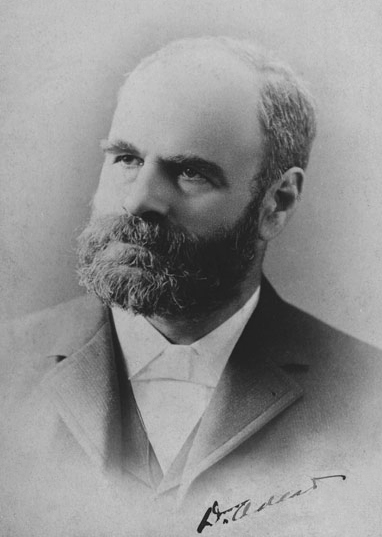
Dankmar Adler (1844-1900) was an American architect born in Germany who was known for his skill with acoustic design. He immigrated to the United States in 1854 with his father, where they settled in Detroit and his father became a rabbi. Adler left school to become a draftsman and eventually moved to Illinois, where he also served in the Civil War with the 1st Illinois Light Artillery Regiment.
After the Civil War, Adler worked as an architect at various firms, until beginning a partnership with Edward Burling known as Burling & Adler, which built more than 100 buildings in reconstruction efforts after the Chicago Fire of 1871, most notably the 1879 Central Music Hall Block (demolished).
Adler began his own firm in 1879, shortly after completing the Central Music Hall. Sullivan was hired as a draftsman in 1880 and became a partner three years later.
After Adler & Sullivan dissolved and Adler left his job at the elevator company, he returned to practice with his two sons, but he never regained the prominence his firm had had in the early 1890s. He had also asked Sullivan to reestablish Adler & Sullivan, but he was rebuffed, as Sullivan may have considered his departure as a betrayal. However, the two made up and remained close friends until Adler's death.
Some sources assert that Temple Isaiah (Ebenezer Missionary Baptist today), completed in 1898, was Adler's last building. However, The Complete Architecture of Adler & Sullivan states his last individual building was the Dispensary Building for the United Hebrew Charities (later the Odessa Hotel, demolished 1960), which was completed in 1899, and the very last project the book lists is an addition to Adler & Sullivan's 1891 Standard Elevator Company factory. Dankmar Adler died in 1900.
Louis Sullivan

Louis Henry (alternatively Henri) Sullivan (1856-1924) was a highly influential American architect. He is probably best known to the layperson for his famous utterance "form ever follows function," which established the doctrine that Modern architecture would soon follow, and for his mentorship of Frank Lloyd Wright. However, to historians, Sullivan pioneered a method of architectural expression on his skyscrapers that would inform their design at large for decades following his firm's work. In addition, his distinctive method of ornamentation that combined vegetal and geometric motifs may be the most unique and detailed architectural decoration to have ever existed.
Louis Sullivan was born in Boston in 1856, the son of Irish immigrant Patrick Sullivan and Swiss immigrant Andrienne List Sullivan, who had both immigrated to the United States in the 1840s. Sullivan was a gifted student and graduated high school early, skipping two years of classes at MIT through his performance on exams. He entered college at 16 and studied for one year before moving to Philadelphia in 1873 to work as a draftsman for similarly innovative architect Frank Furness. However, the Depression of 1873 greatly reduced Furness's work, and he was forced to lay Sullivan off.
Sullivan moved to Chicago in 1873 to capitalize on the rebuilding following the Chicago Fire that Adler likewise took part in. He briefly worked for William Le Baron Jenney, and he then moved to Paris to study at the Ecole des Beaux-Arts. After returning to Chicago, he was a draftsman for Joseph Johnston and John Edelman.
Sullivan was hired by Dankmar Adler in 1880, and three years later he was made a partner of the firm, forming Adler & Sullivan. The firm had several notable commissions through the 1880s and 1890s, beginning with the Auditorium Building (completed 1890, though it opened in stages). Prior to the Auditorium, Adler & Sullivan were known for theater designs and more modest commercial buildings, but beginning in the 1890s, they built more high-rise office buildings. Sullivan's commissions afterwards included the Wainwright Building in St. Louis, perhaps the first properly expressed early skyscraper, and the Transportation Building at the 1893 Columbian Exposition, the only building at the fair not in the Beaux-Arts style.
Since Adler was the one who brought in much of the firm's commissions, Sullivan's following solo practice beginning in 1894 was less successful. After the Carson Pirie Scott Department Store's completion in 1903 (the Sullivan Center today), Sullivan hardly received any commissions at all. The following decades of his life were characterized by financial problems and alcoholism. The few commissions he did receive were mainly small commercial buildings and banks in the Midwest, the latter being known as his "jewel boxes." He even resorted to mundane commissions such as statue pedestals, residential garages, and tin platforms for iron stoves.
Sullivan's last commission that was a complete work of architecture was the Farmers & Merchants Bank in Columbus, Wisconsin; his final work on a building was the facade of the Krause Music Store in Chicago; and an assertion from the president of the American Terra Cotta and Ceramic Company in the book The Idea of Louis Sullivan claims "his last commission was not a building at all. Some hardware company had him do an ornamental design for one of those tin platforms that stood under the old pot-bellied stoves...I don't know whether the thing was ever produced or not." (Richard Nickel found two of these plates while cleaning the attic of his aunt's house.) Sullivan died in a hotel room on April 14, 1924.